Early Origins
1971: George Bergman The logarithmic limit-set of an algebraic variety
- Take the (complex) points defined by \(f(x, y) = 0\)
- Map every point \((x, y)\) to \((\log_b |x|, \log_b |y|)\)
- Take the limit of this set as \(b \to \infty\)
- … limit of a set?
- just go with it…
A Tropical Curve
![]()
A Tropical Line
Primes and Valued Fields
Let \(p\) be a prime number.
Definition 1 For integers: \[ v_p(n) = \text{the largest power of $p$ that goes into $n$} \]
Definition 2 For rationals: \[ v_p(m/n) = v_p(m) - v_p(n) \]
Example 1 \[ v_5(200/125) = v_5(5^2 \cdot 2^3) - v_5(5^3) = 2 - 3 = -1 \]
Arithmetic
- Same value no matter how we express a fraction: \(v_5(200/125) = v_5(8/5)\)
- \(v_p(x \cdot y) = v_p(x) + v_p(y)\)
- \(v_p(x / y) = v_p(x) - v_p(y)\)
- \(v_p(x^k) = kv_p(x)\)
Min-property
\[v_p(x + y) \ge \min\{v_p(x), v_p(y)\}\]
- e.g. \[\begin{align*}
v_5(250 + 200) &= v_5(5^3 \cdot 2 + 5^2 \cdot 2^3) \\
&= v_5(5^2(5 \cdot 2 + 2^3)) = 2
\end{align*}\]
- More precisely: if \(v_p(x) \neq v_p(y)\) then \(v_p(x + y) = \min\{v_p(x), v_p(y)\}\)
- If \(v_p(x) = v_p(y)\) then \(v_p(x + y)\) can be any value between \(v_p(x)\) and \(\infty\) (as long as \(p \neq 2\))
- Wait, what happens when \(p = 2\)?
- Investigate yourself!
- e.g. \(v_2(12) = v_2(20) = 2\) but \(v_2(32) = 3\)
Equations over valued fields
\[x + y - 1 = 0\]
How do \(v_p(x)\) and \(v_p(y)\) relate?
- If the minimum of \(v_p(x), v_p(y), v_p(-1) = 0\) is unique
- \(v_p(x + y - 1) = \min\{v_p(x), v_p(y), 0\}\)
- \(v_p(x + y - 1) \neq v_p(0) = \infty\)
- \(x + y - 1 \neq 0\)
- So the minimum is not unique
- It occurs at least twice
“Curves” over valued fields
Start with an equation:
\[V(x + y - 1) = \{x + y - 1 = 0\}\]
Tropicalize:
\[V(\bar{x} \oplus \bar{y} \oplus 0) = \{\text{min occurs at least twice}\} \]
Notation: \(V\) means vanishing set or variety, \(\oplus = \min\).
Minimum occurs twice
\[\min\{\bar x, \bar y, 0\}\]
Cases:
- \(\min = \bar x = \bar y \le 0\)
- \(\min = \bar x = 0 \le \bar y\)
- \(\min = \bar y = 0 \le \bar x\)
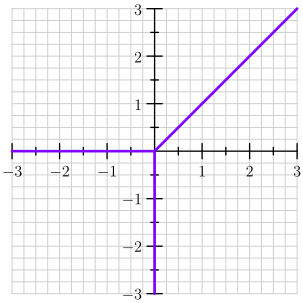
Min-convention Tropical Geometry
![]()
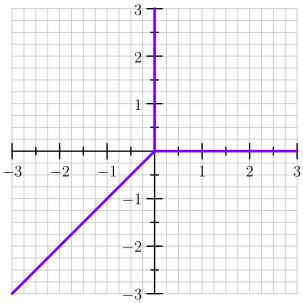
…And it’s upside down
The two conventions
- Min-convention \(v_p, \min, v_p(0) = \infty\)
- Max-convention \(|x|_p = p^{-v_p(x)}, \max, |0|_p = - \infty\)
- exponential can have any base but \(p\) is the convention
Triangles
How to compute the tropical curve associated to a tropical polynomial?
\[ f(x,y) = 75 + 10x - 12y + 25xy \]
Record the valuation \(v_5\) at each monomial:
\[ \mathrm{trop}(f) = 2 \oplus \bar 1x \oplus \bar y \oplus 2 \bar x \bar y \]
Recipe
- For each term \(a\bar x^m \bar y^n\) lift the point \((m, n)\) up to a height of \(a\).
- Wrap those points on the bottom with a sheet (lower convex hull).
- Use the folds in the sheet to draw polygons between the points \((m, n)\).
- The tropical curve is the dual graph of this complex.
- Rotate 180 degrees for min-convention
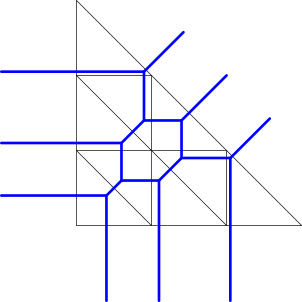
A tropical elliptic curve
![]()
A degree 3/genus 1 tropical curve
Tropical Bézout
![]()
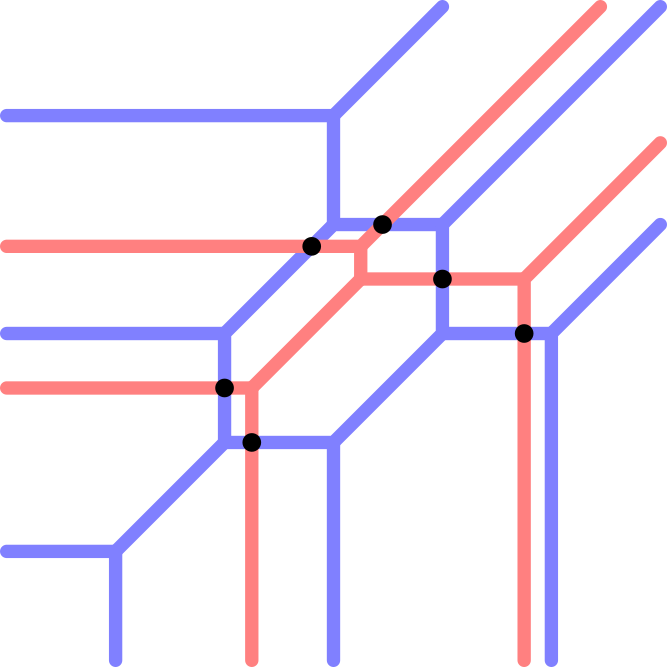
Bézout’s theorem for tropical curves: a degree 3 and degree 2 tropical curve intersect in 6 points generically
Mixed Subdivisions
![]()
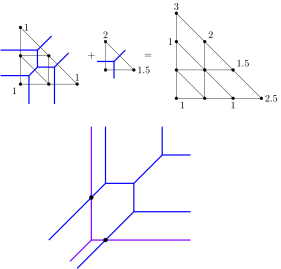
Cells corresponding to intersections are quadrangles. Multiplicity of intersection = area of quadrangle
Part II: Points on Curves
Elliptic Curves
A smooth cubic curve is called an elliptic curve
Weierstraß form \[ y^2 = x^3 + px + q \]
As complex surfaces these are toruses (genus 1)
Abstract Tropical Curves
![]()
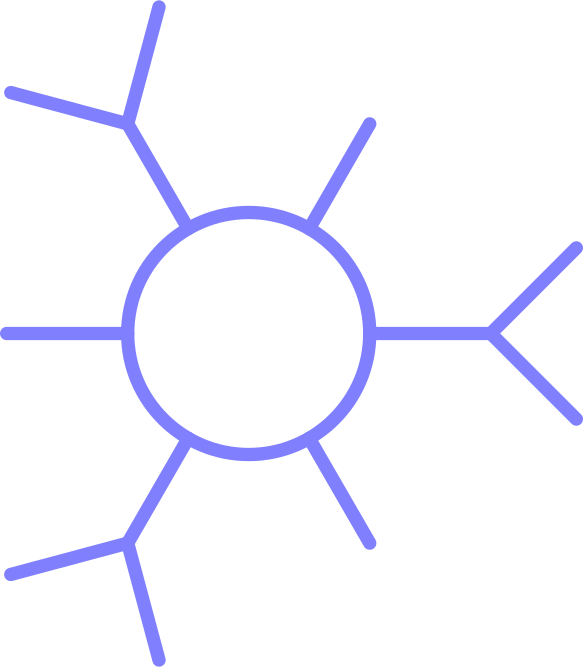
An tropical curve
Abstract Tropical Curves
![]()
An abstract tropical curve
Abstract Tropical Curves
![]()
An abstract tropical curve (skeleton)
Source
- Imagine we have an equation \(f(x,y)\) with integer coefficients.
- We can reduce mod \(p\) to curves over the mod-\(p\) number system.
- If we have a good equation, i.e. a bad equation, this reduced equation will have self-intersections and intersecting components
- components correspond to points
- intersections correspond to connections
Dollars on Graphs
![]()
Points on an abstract tropical curve
- For a classical curve: \(P + Q + R = 0\) if they are colinear
- For a tropical curve we have borrowing moves
Dollars on Graphs
![]()
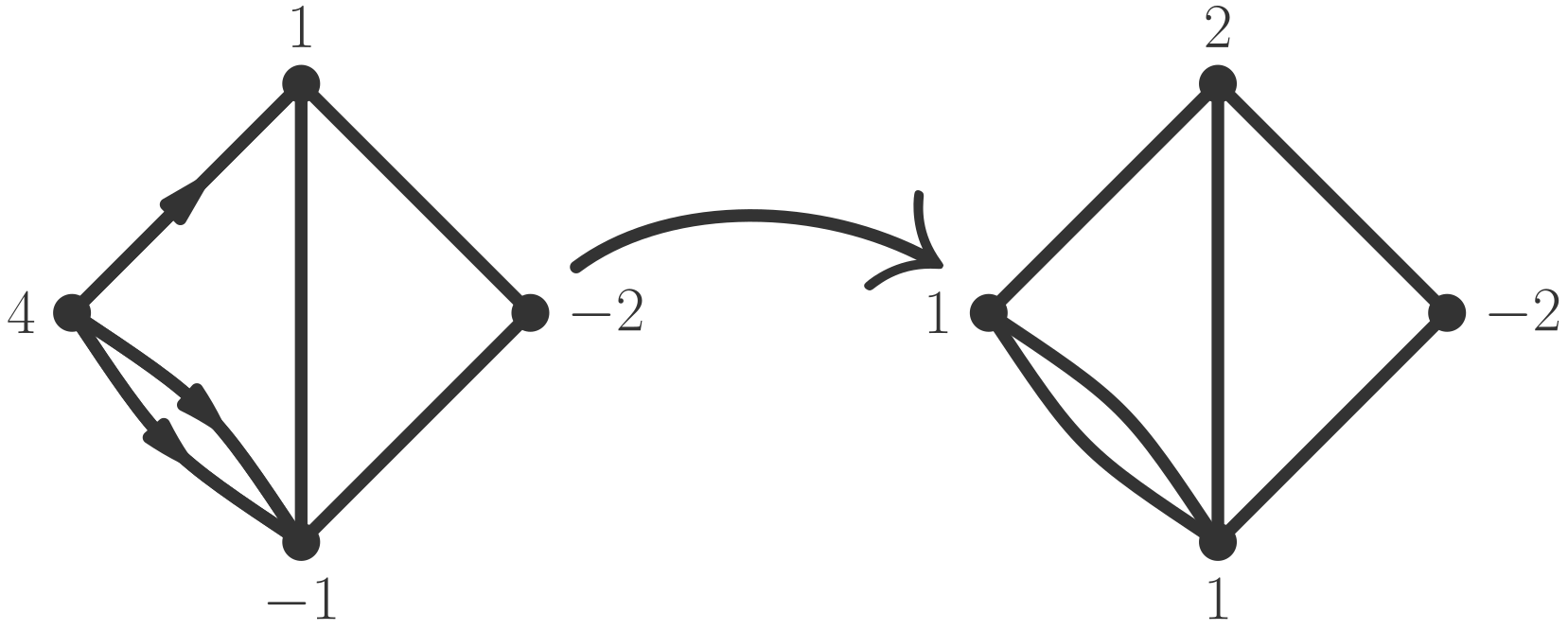
Borrowing/Lending Move
- At any point, a vertex may send 1 dollar simultaneously to each of its neighbours
- Question: can we get everyone out of debt?
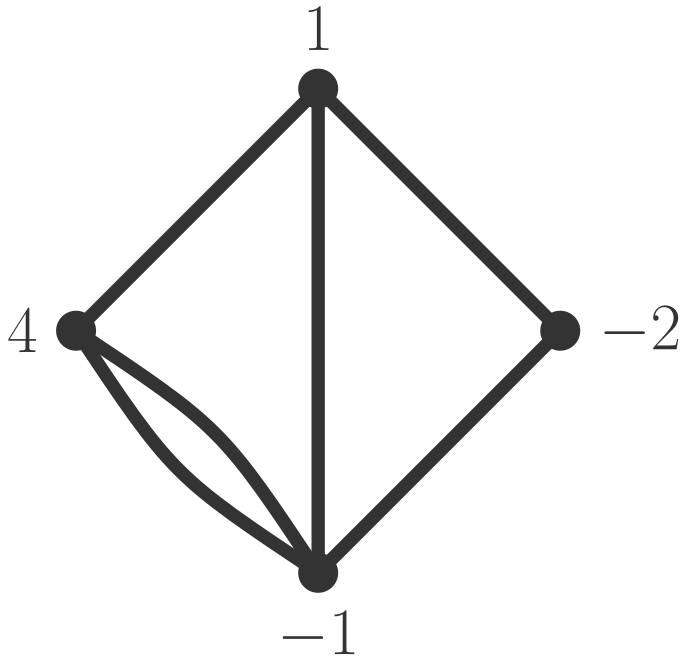
Example 1
![]()
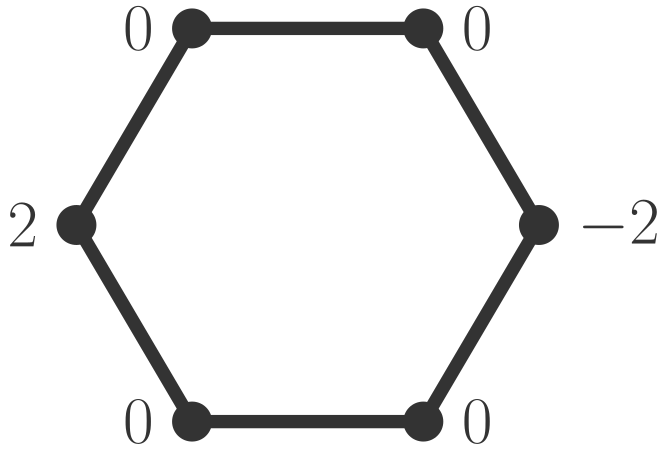
Can you win the dollar game?
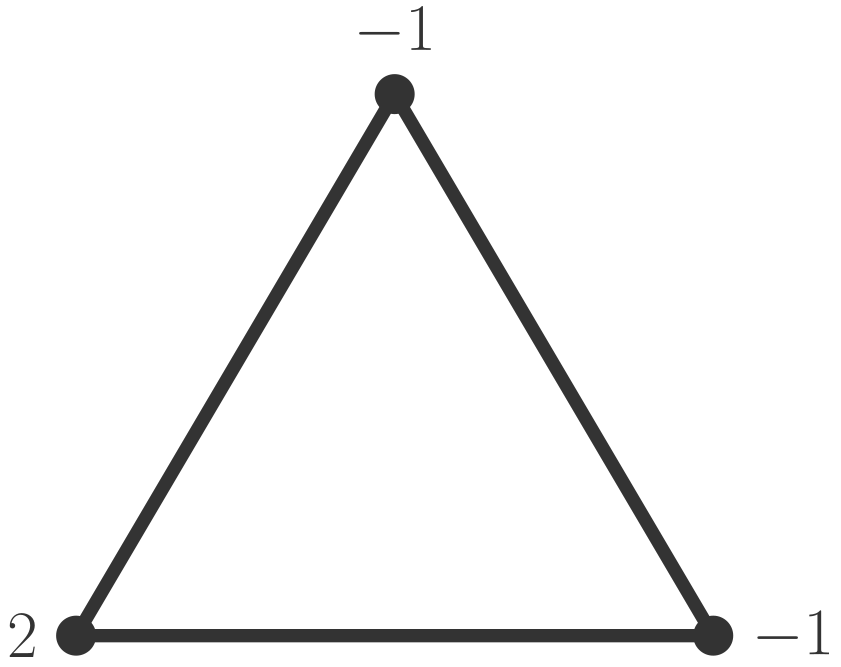
Example 2
![]()
Can you win the dollar game?
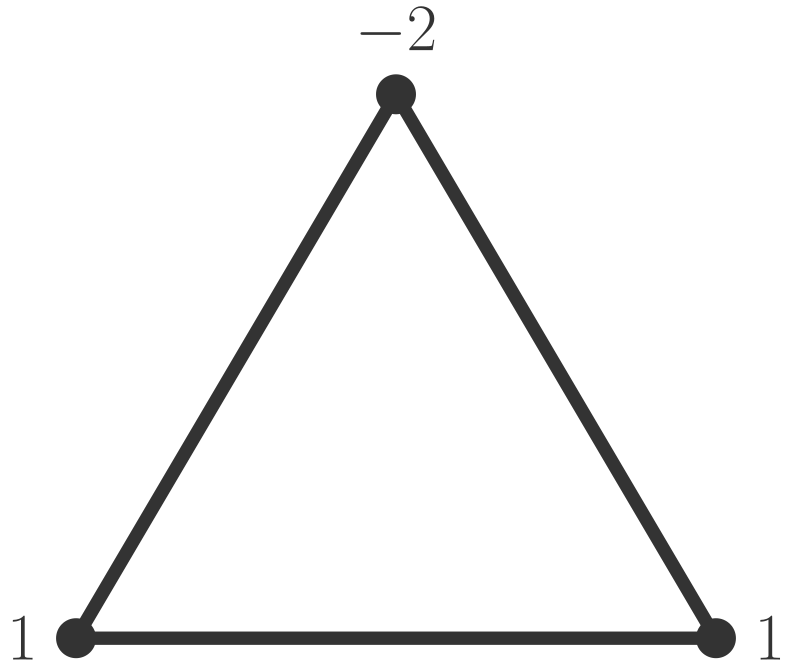
Example 3
![]()
Can you win the dollar game?
Rank Function
Let \(D\) represent a given dollar game.
- If \(D\) is unwinnable, define \(r(D) = -1\)
- If \(D\) is only just winnable, i.e. \(D\) is winnable but if we take a dollar away from \(v\), \(D - v\) is unwinnable, define \(r(D) = 0\)
- Say \(r(D) \ge k\) if taking away any \(k\) dollars anywhere leaves a winnable game
- \(r(D)\) will be the maximum \(k\)
Degree Function
\[\deg(D) = \text{total dollar amount of } D\]
Riemann-Roch Theorem
If a graph has genus \(g\) then for any game \(D\)
\[r(D) \ge \deg(D) + 1 - g\]
Classical Riemann-Roch
If a surface has genus \(g\), and \(D\) is a finite set of points with multiplicities. Consider the set of rational functions whose poles are not worse than the numbers specified in \(D\).
E.g. \[f = \frac{(x + 2)^4(x - 3)}{(x + 5)^3(x - 7)}\]
\[\mathrm(f) = \{4 \text{ at } -2, 1 \text{ at } 3, -3 \text{ at } -5, -1 \text{ at } 7\}\]
This is ok for \(D\) = no worse than \(-3\) at \(-5\) and no worse than \(-2\) at \(7\).
Classical Riemann-Roch (cont.)
A sum of two rational functions which is ok for \(D\) is also ok for \(D\). Likewise any constant multiple is ok for \(D\).
I.e. it is a vector space
Let \(\ell(D)\) be the dimension of this space.
Theorem 2 (Riemann-Roch) \[\ell(D) \ge \deg(D) + 1 - g\]